Showing posts with label DIY. Show all posts

Saturday, April 30, 2022

Husqvarna YTH 22V46


I've had this mower for a couple of years (bought it used) and it's always run like a champ.  The only thing I've done to it since I bought it was change the oil, spark plugs, and air filter.  I also switched out the blades for mulching blades.  A few days ago, I was mowing and the mower suddenly stopped running.  It behaved as if I had tripped a safety switch.  The local repair shop wanted a $35 pick up fee plus $$$$ bench time, and said they would have to keep the mower for two weeks.  Two weeks!  You know how tall my grass would be in two weeks?  I decided to see if I could solve the problem myself. 

Because of the sudden way the mower stopped running, I decided it wasn't fuel.  Plus, there was gas in the tank and it hadn't been sputtering.  So, not fuel.  Had to be fire, right?  I thought I would start with something easy, so I disconnected the battery to see if it would reset any tripped safety switch.  No joy.  (The battery tested fine, by the way.)  Next, I decided to change the one and only fuse on the mower.  Easy and cheap, right?  The owner's manual said the fuse was located behind the dash.  Indeed it was.  Way, way, way behind the dash.  This mower has the battery box in the rear, under the seat, and I found the fuse under the right fender after I removed the battery.  So, "behind the dash" meant tucked up under the rear fender.  
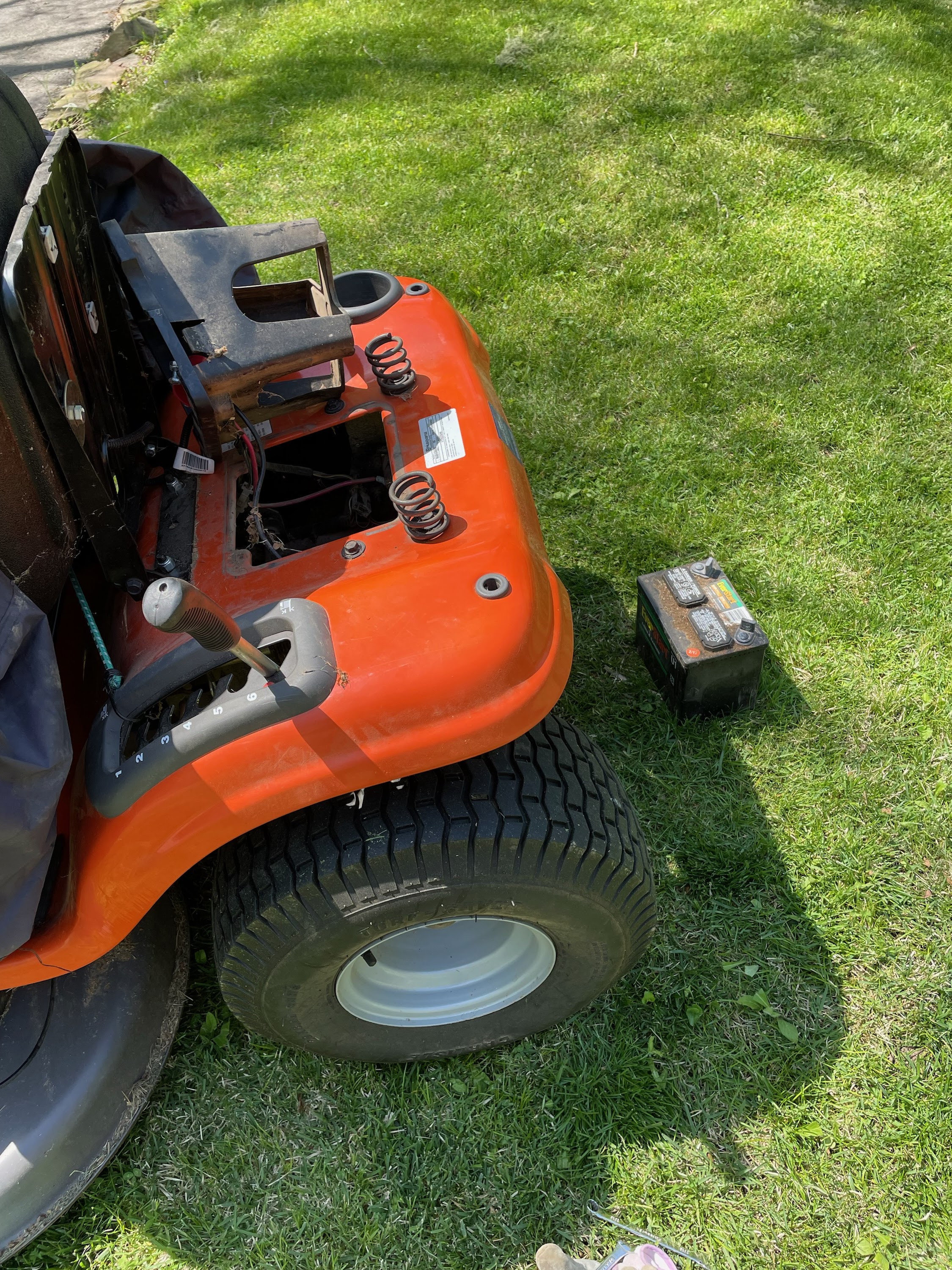


The new fuse didn't solve the problem.  Rats!  

The solenoid was located right next to the fuse.  I'd never had a solenoid go bad on a riding mower.  But, it was easily accessible.  It was electrical.  And it would be a cheap part and easy to replace if it was bad.  


I put a screwdriver across the two screws you see in the photo above and the starter spun, which meant the solenoid was bad.  If you decide to bridge the two screws with a screwdriver, be prepared for a couple of sparks and please don't burn down your garage!  Safety first, people.
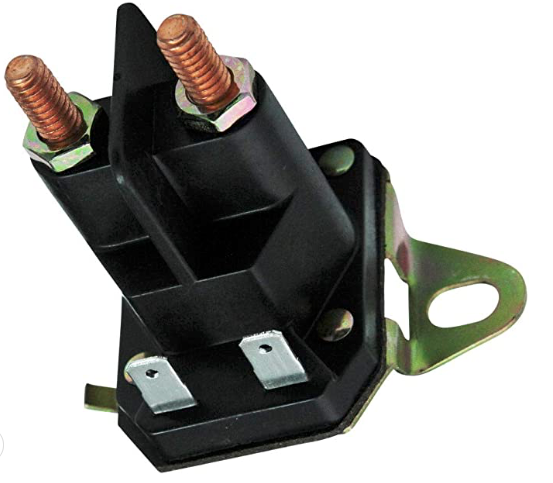

Removing the solenoid was easy.  I disconnected the two nuts with lock washers attached, removed the wires behind the nuts, unplugged the two connectors under the wires, and removed the bolt that holds the solenoid to the mower body.  A local auto sports shop had the correct solenoid for around $15.  


This is what the nice, new, clean solenoid looked like.  Installation took only a few minutes.  After I installed it and reconnected the battery, the mower fired up and was ready to go.  

The moral of this story: Don't trust the manual and don't be afraid to get your hands dirty.  Time to mow!  


Wednesday, November 23, 2016

Thanksgiving Pumpkin


Pumpkin muffins, anyone?!?!?

The day after Halloween, I bought a pumpkin for $1 at Walmart and put it in the garage where it's cool. Today, the day before Thanksgiving, I chopped it into six chunks and stuck it in the oven at 350 degrees for 45 minutes. After the pumpkin finished baking, I let it cool for a few minutes, peeled off the skin, and ended up with a heaping two quarts of pumpkin flesh pieces. 


After a few minutes with the potato masher, the pieces were reduced to a nice mash.


We used some of the mash to make pumpkin muffins, which are excellent. We set some aside to eat with dinner tonight, saved two cups to make a pumpkin pie tomorrow, and froze the rest to add to soups this winter. We're definitely getting our money's worth out of a $1 pumpkin. 

Happy Thanksgiving, Everyone!  


Monday, October 31, 2016

Sewing Machine Stool


About a year ago, I began looking for a stool to match a mid-century modern Copenhagen-style sewing machine cabinet. I found several which were too expensive (more than $100) and one which needed too much restoration work (the legs were painted blue and the seat had been recovered with a printed patchwork cotton fabric). Finally, a month ago, I found a stool with a reasonable price ($20) and its original upholstery. The upholstery was in good shape, but the legs needed some work.

The legs had a coat of tan paint over the original blonde finish and they’d been scuffed up a bit.


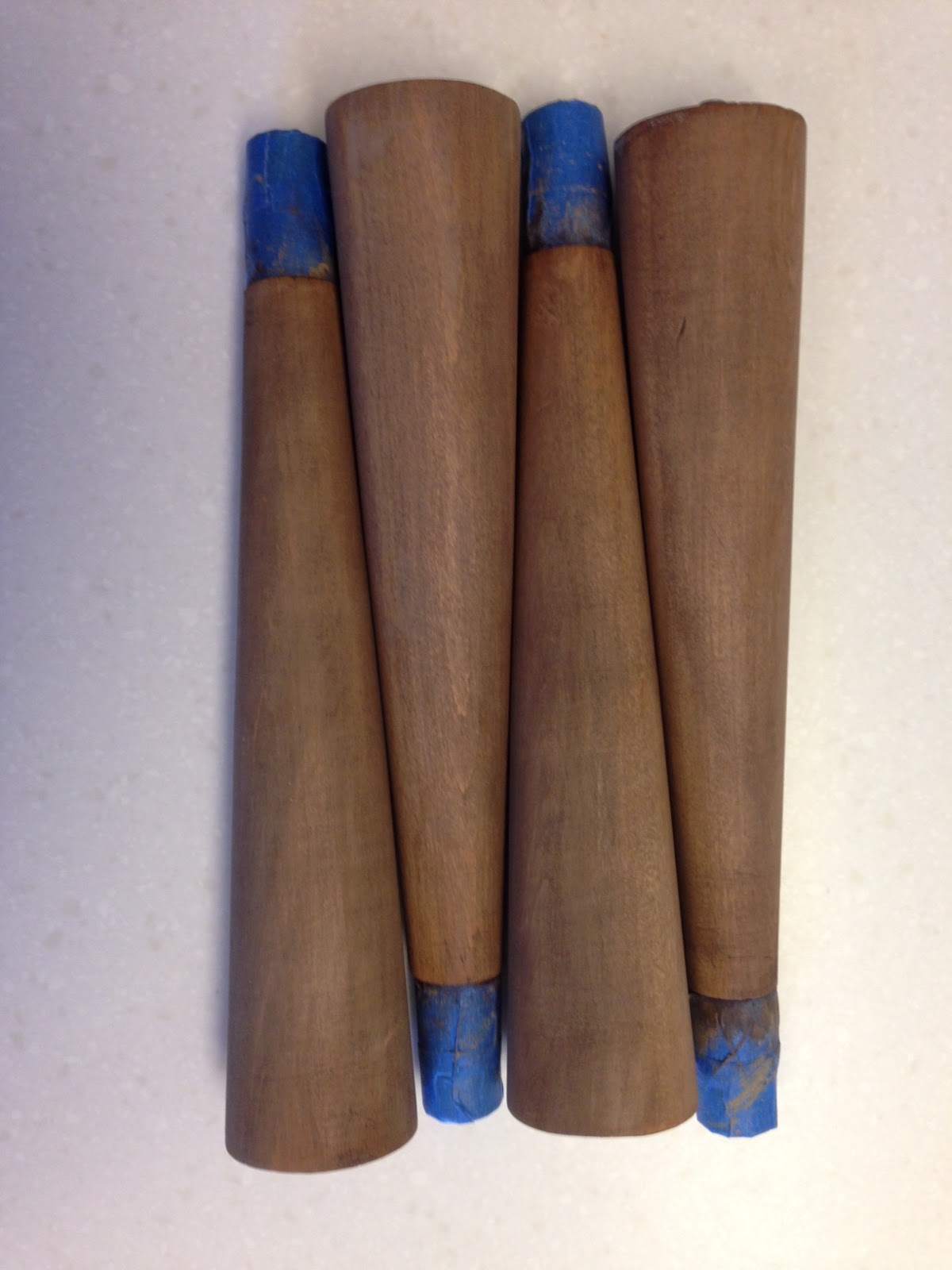
I didn’t care about the paint or the scuff marks because I was going to refinish the legs to match my cabinet. I used wood stripper and a teflon pad to remove the old paint and the original finish.


Next, I applied a walnut stain which I knew would be too dark. I wiped off most of the stain immediately after I applied it and then used mineral spirits to make the walnut stain even lighter.


I brushed on a coat of polyurethane which contained a cherry stain. If I’d wanted the legs to be more red, I could have applied another coat of the polyurethane/stain, but they were exactly the color I wanted after one coat. 


I’m thrilled to pieces with my “new” stool and I'm sure I'll use it a lot. Happy Sewing everyone!

Sunday, July 31, 2016

Renovated Bird Bath


Our bird bath developed a bunch of cracks and would no longer hold water. It was a shame, because the bird bath was great. It’s made from light weight plastic and has a little solar panel in the middle which runs a pump so the birds can have a shower as well as a bath. For a while, epoxy worked to seal the cracks and stop the leaks. Eventually, though, epoxy couldn’t keep up with the cracks. When we looked for a replacement, we couldn’t find anything we liked.

Plasti Dip to the rescue! If you haven’t used Plasti Dip before, enter it as a search term on youtube and you’ll see people using it in all kinds of creative ways. It’s a product which creates a flexible plastic barrier that feels sort of like rubber. We used a can of yellow Plasti Dip (because that’s what we could find) and a paint brush to fill and cover the cracks in the bird bath. We didn’t want a yellow bird bath, so when the yellow Plasti Dip dried/cured, we used a rattle can of gray Plasti Dip to cover the entire top surface of the bird bath.


Plasti Dip was easy to use and worked exactly as we hoped it would. 


The bird bath is now getting heavy use and isn’t leaking.  The birds are happy and we are, too. 


Monday, February 8, 2016

DIY Cutting Table


For a long time, I used my dining room table as my fabric cutting table. I liked the large work surface, but I didn't like the low height of the table (oh, my aching back!) and I didn't like making a mess in the dining room every time I cut a piece of fabric.

Eventually, I abandoned the dining room table and started using the twin bed in the spare bedroom as my cutting table. I put a hollow core door on top of the bed and used bed risers (those plastic things you put under the feet of a bed to raise it up) to make the work surface higher. I liked having a higher work surface, but it wasn't ideal because there was no overhang which meant I was bending over the whole time I was using it. Plus, I didn't like giving up the spare bedroom. And, the hollow core door wasn't as large as my cutting mat, which is 3x4 feet.

I looked online to see if I could find a cutting table I liked. A lot of them weren't tall enough for me. Others were designed to hold a sewing machine, which I didn't need. Others had lots of drawers, but I wanted a large open space under the table. Still others were (in my view) ridiculously expensive.

So, one morning after breakfast, I made a quick sketch of what I wanted and E headed to the shop. The end result was my new cutting table. The table top is 4x4 feet of 3/4 inch plywood, which is big enough for my cutting mat and leaves space along the back edge for a lamp, fabric weights, boxes of pins, etc. The framework is made of 2x4s and it's 36 inches wide and 33 inches deep, so I have a nice overhang on each edge. The wheels caster so I can roll it around the room in any direction and wherever I want. The height to the top of the work surface is 37 inches, which is exactly what I wanted. The sides and the back are pegboard where I can hang my rulers and my smaller cutting board. In the big open space in the front, I put an old two-door chest which holds all of my spray "stuff" -- starch, sizing, temporary bond, permanent bond, etc. Next to the chest is my embroidery machine. (Pay no attention to the cow. She's purely decorative.)


My sewing room is on the second floor of our house and there was no way we could possibly carry this up a flight of stairs or get it through any of the doors. So, we turned it into a flat pack and put some of the pieces together in the shop, carried them upstairs to the sewing room, and assembled it there.

I am thrilled with my cutting table and look forward to using it soon. Happy sewing, everyone!

Thursday, November 12, 2015

Mailbox v. Vandals


When we moved here in 1979, we took a look at the dented, lopsided, spray painted, uprooted mailboxes of our neighbors and decided to get a post office box in town instead of having a mailbox at the top of the driveway. This worked fine until the past couple of years when the MVA began addressing mail to our house instead of to our post office box. Because we didn’t have mail delivered at the house, the post office simply returned our mail to the MVA. Driver’s license renewals? Returned to the MVA. Registration renewals? Returned to the MVA. Ack! So, after 36 years, we bought a mailbox, painted our house number on it, set a post in the ground, mounted the box on an arm on the post and waited for the MVA to send us something.

The mailbox was up for not quite two months before the local vandals discovered it. Two weekends out of the last three, our mailbox was pulverized. The first time, it was dented and the little red flag was ripped off. We took the box down, pounded out the dents, riveted the flag back onto the box, and re-mounted it on the post. The second time, the little turds beat the living daylights out of it. In addition to being dented, the bottom of the box was torn from the top, the door wouldn’t close, the arm on the post was twisted and the post was leaning to one side. The photo above shows the mailbox after the second round of repairs. Believe me, it looked a heck of a lot worse before we worked on it.

We hated to remount the box, only to have it vandalized again. Internet research revealed all kinds of interesting ways to defeat mailbox vandals. Unfortunately, some of the ideas were super expensive. Others were a heck of a lot of work. Still others seemed likely to injure either the vandals or to pose a hazard if a motorist ran into the post. We eventually found one idea, though, which made a lot of sense and after the second time we beat our mailbox back into something resembling a mailbox, we put the idea into practice.

The underside of our box has two brackets on it. When we put the brackets back on the box after repairing it the second time, we added two long nails which poke down through the brackets. The distance between the nails is the same as two pre-drilled holes on the arm of the post.


We drilled two holes in a piece of wood and mounted it to the arm of the post so the holes line up with the two pre-drilled holes on the arm. We also mounted our newspaper box to this with cable ties.  


Then, we put a handle on top of the mail box. Now all we have to do is slip the two nails into the holes each morning to mount the box. Then each evening, we grab the box by the handle, pick it up, and bring it (and the mail) back to the house.


This is a tiny bit of extra work for us, but it’s no big deal. With any luck, the vandals will leave the post and the newspaper box alone. Fingers crossed.  

Monday, September 28, 2015

Hot Pepper Relish


Recently, we picked 20 pounds of peppers from our garden. We didn't want to freeze them because we've been freezing peppers all summer and we have enough frozen to last through the winter. We didn't want to use them fresh because we have plenty of fresh peppers left in the garden and because even though we love peppers, it would take us quite a while to eat 20 pounds of them. So, we decided to make pepper relish. 

Half the peppers we used were mild -- orange, red, and green bell plus some red banana peppers. 


The other half were chilies, jalapeños, and some little red fireballs which are a lot hotter than either the chilies or the jalapeños. They taste like I imagine molten lava would taste. One of my aunts gave us the seeds for these years ago and we've grown them (and saved the seeds) ever since. 


We seeded the mild peppers and the jalapeños, chopped up all of the peppers and some onion, added sugar, salt, cider vinegar, and mustard seed, and set things on the stove to boil.


Then, we filled pint jars and processed them in a hot water bath.  


We thought this batch would be warm, not hot, because only half of the peppers were hot. Instead, we ended up with 15 pints of the hottest relish we've ever made. We plan to add a little bit to anything that needs some zip. A very little bit! 

Friday, December 26, 2014

Button Foot Controller Repair


My Singer 401 has a button foot controller which I use by way of a knee bar. Until recently, the 401 had one speed – 100 m.p.h. It was polite enough to wait until I pressed on the knee bar before it started sewing. But, once it started, it went flat out all the time. E took it apart and fixed the problem and I thought I'd share how he did it.

You'll want to take a look at what Sid had to say about button foot controllers in his February 22, 2012 post at http://oldsingersewingmachineblog.com. Sid explains how the controller works and he has some great photos of the inside of the controller which will be helpful to you as you keep reading this post. (Thanks, Sid!)

E unscrewed the little feet on the bottom of the controller and took the top off the base. Someone had already removed the capacitor from between the two terminals, so it wasn't causing a problem. As you can see from Sid's photos, there's a screw which runs all the way through the white porcelain case which contains the variable resistance. The tip of the screw pokes up toward two little rectangular copper contacts and has a little plate attached to it. The little plate that's attached to the tip of the screw ought to touch the copper contacts when you have the button on the foot controller pressed all the way down. This gives you a resistance-free path from one terminal to the other and this is what gives you full speed.

When E looked inside my controller, he saw that when he pushed down on the t-shaped lever the button sits on, the little plate was touching the copper contacts well before the t-shaped lever was pushed all the way down. This explained the 100 m.p.h. speed.

To fix the problem, E slightly turned the screw clockwise which moved the little plate lower on the screw. He kept turning the screw until the little plate was barely touching the copper contacts when the t-shaped lever was pressed all the way down.


The button controller is back in the 401's cabinet and it works great. If you're having a similar problem, you might want to grab a screwdriver and give this a try. Happy Sewing!   

Tuesday, December 23, 2014

Singer 201


I'd been looking for a Singer 201 for a while and found one on craigslist which was advertised as not working. The seller was asking a fair price for a sewing machine which wouldn't sew, and E and I decided to buy it and see if we could revive it.

The machine came in a cabinet which held the original attachments and the manual.


We were planning to junk the cabinet, but decided to keep it because it's less than 30 inches long (with both leaves folded up) and we knew we could find room for it somewhere in the house. As you can see, E did a beautiful job of refinishing it.

Here's what it looked like when we brought it home. Lots of nicks, scratches, and dings.


And here's what it looks like now, after E refinished it.  Beautiful, eh?


Before we took the machine out of its cabinet, we did some preliminary diagnostic work. We plugged it in and flipped its little white toggle switch. The light came on and nothing smelled like it was burning, both of which were encouraging signs. Next, we tried to turn the hand wheel. It wouldn't budge. After ruling out a few other possible causes, we figured there must be a jam under the rotating hook assembly. Sure enough, when we removed the assembly, there was the tangle of doom. After we removed it (we needed tweezers and a flashlight) and put the assembly back together, we were able to spin the hand wheel.

The machine's cabinet had a built-in foot controller which didn't work. However, there was an after-market foot controller installed on the machine and when we very briefly pressed on it, the motor hummed and the needle bar went up and down.

Next, we took the machine out of the cabinet, blew the dusty bits out of its nooks and crannies, and polished all of the shiny parts. It looked good. But would it sew?


After we oiled and lubricated it, we took it for a test drive. There was a problem with the thread tension which ended up being a problem with the bobbin thread tension. After a little bit of adjustment, the thread tensions were balanced and the 201 was ready to sew.

This 201, which was made in 1950, purrs like a kitten and sews a beautiful stitch, plus the cabinet is gorgeous. I'm happy to add it to my herd.


Tuesday, December 9, 2014

Embroidery Machine + Refnished Sewing Machine Cabinet

I got a new toy a few weeks ago. No, it isn't another sewing machine. It's an embroidery machine! Hancock Fabrics had the Brother HE1 on sale and after I watched a HSN youtube video about this model, I decided to get one. It's a pretty basic machine, but the price was great.


The machine was easy to set up. All I had to do was snap the carriage onto the bed, plug in the power cord, and turn it on. It comes with enough gear to let you use it right away. Brother included a spool of bobbin thread plus several bobbins, three spools of upper thread, a 4x4 inch hoop and three sheets of stabilizer. There's also a plastic dust cover and a few miscellaneous bits (seam ripper, stylus, spool caps, etc.). The manual is thorough and easy to understand.

For my first project, I embroidered the name of one of my sister's dogs onto fabric I made into a reversible scarf. The combination of thin fabric and a high stitch count resulted in a lot of puckering.  Still, not too bad for my first try.


I bought 63 spools of thread from an eBay seller who shipped them really fast. The spools in my local fabric stores are $6 each (ouch!) so I was happy to find a good seller online. There are a lot of web vendors who have embroidery designs and alphabets available, and some of the designs are free. I was looking for some interesting, inexpensive alphabets and I found www.8clawsandapaw.com which sells them at reasonable prices.

I downloaded a couple of free designs onto my Mac, put them on a USB stick, blew the dust off an old IBM laptop running Windows XP (the Brother isn't compatible with Macs), and plugged the USB stick into the laptop. Then I connected the laptop to the embroidery machine using the cable which came with the machine, and dragged the designs from the USB stick onto the drive for the embroidery machine. When the designs showed up on the machine's LCD screen, I saved them there. You can only save a few designs to the machine, but you can load as many as you want onto your Windows-based computer and send them directly to the machine whenever you want to use them. The machine has a slot for embroidery cards, too.

I also downloaded an iPad app called StitchBuddyHD, which allows me to combine designs, change colors, re-size designs (within limits), etc. I played around with it quite a bit and I liked it enough get the Mac version of StitchBuddy which allows me to do even more things. (If you have a Mac, StitchBuddy lets you download it and try it for free a few dozen times.) StitchBuddyHD and StitchBuddy for Mac allowed me to change the colors of this plane's paint and eliminate a window. Then I combined the plane design with the numbers and letters built into the machine.


Even though I said I wasn't going to post anything about a refinishing project for a while, here I go again. E spotted a Copenhagen style Singer sewing machine cabinet at the local thrift store for $15. As you can see, it was in sad shape before E sanded it, stained it, and sealed it.


I want to use the cabinet for my embroidery machine, so E took some pegboard and a couple of 1/4 inch dowels cut into 1-3/8 inch pieces and made spool holders for the two top drawers. The bottom drawer holds stabilizer, the manual, and everything else that came with the machine. Yay!


Happy sewing and embroidering everyone.

Friday, November 21, 2014

Refinishing A Dining Room Table

I swear this is going to be the last post (for a while, at least) about refinishing anything. But, this is a little different from the other things I've posted about, which is why I decided to go ahead and share.

Earlier, we told you we moved everything out of the dining room so we could refinish the floor. When then time came to move everything back into the dining room, we took a hard look at the dining room table. The finish had lots of nicks and scratches and worn spots. This wasn't a surprise because we (mostly me) have put this table through a lot in the last 35 years. I've used it as my cutting table for dozens of sewing projects and as my work bench for stripping off old car seat upholstery and then cutting, sewing, and installing the new upholstery. It's where I start my seedling garden plants in the spring. We've used it to inventory boxes of old car parts. It's no wonder the finish on the table looked so bad.


E used his small orbital sander to take off the old finish, starting with the leaf in the middle. If you look closely at the upper edge of the section on the right, you can see how badly the finish was worn in places. Also, when you look at these "before" photos, notice how the finish hides the grain of the wood.


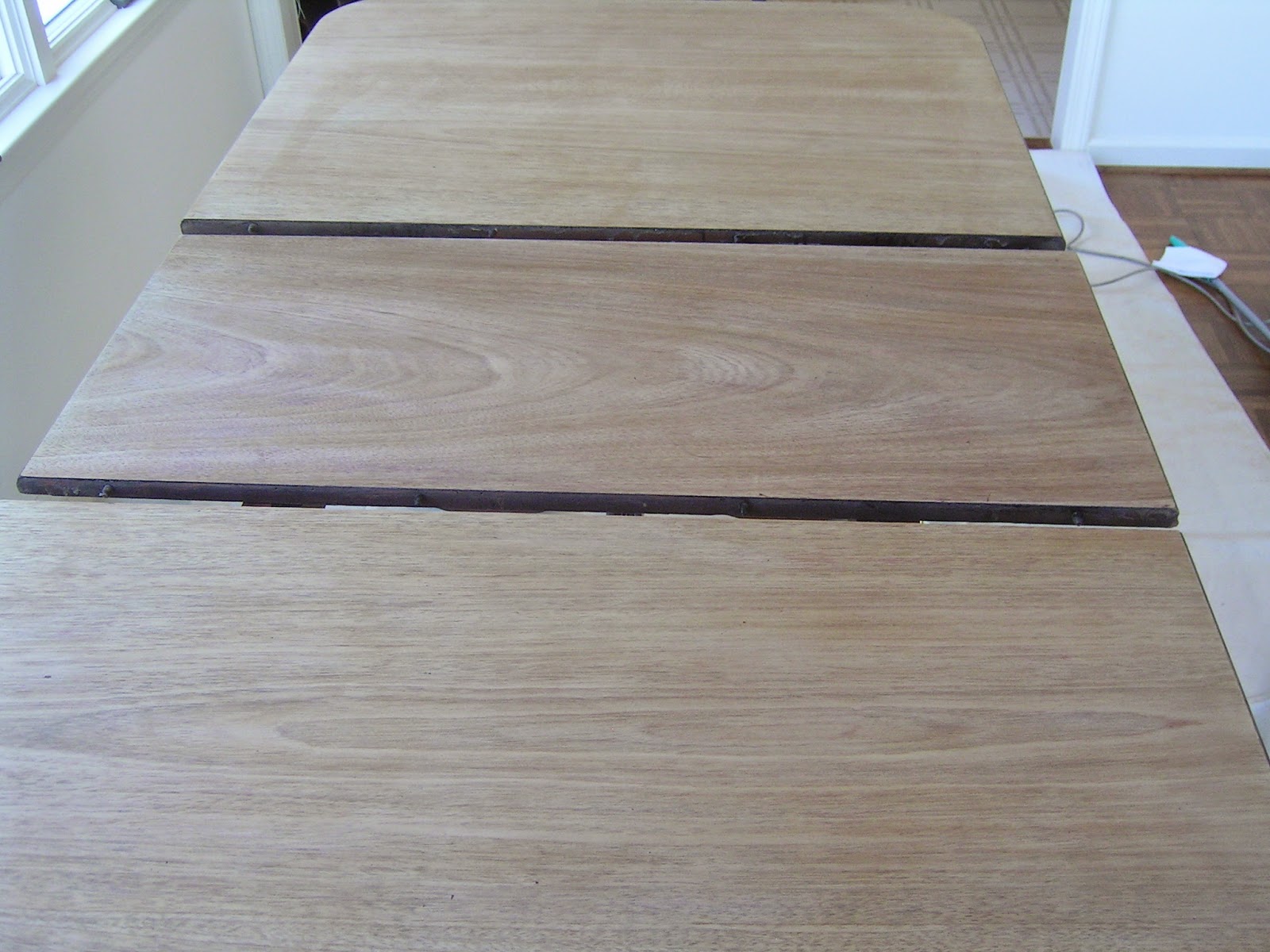
E had the entire table sanded in a couple of hours. It would have gone faster, except we did this inside so he had a bag on the sander to catch the dust and he had to stop sanding and empty the bag every ten minutes. Here's what the entire table top looked like when E finished sanding.


The next step was to stain the table to match the rest of the furniture. Even though we used the lightest mahogany stain we could find, we wiped it off almost as soon as we brushed it on. The directions on the can said to leave it on for five to fifteen minutes before wiping off whatever hadn't soaked into the wood. If we'd done this, the table would have been way too dark.  Here's the table with the stain on it.


Next came six coats of satin finish polyurethane coating.


It hardly looks like the same table, does it? There was a nice wood grain hiding under the old finish and the polyurethane will protect the finish for many years to come.