Showing posts with label Sewing. Show all posts

Sunday, June 4, 2017

Sewing Softies


Lately, I’ve been sewing soft toys for the pediatric ward of a hospital and for two groups which assist foster children. These were a lot of fun to make and a good way to use some of my accumulated fabric.  (Not to worry.  I have plenty of fabric left.) 

The chickens were made from either flannel or bubble fleece.


I used cotton for the mice.  The photos show them before and after they were stuffed.  
My 90-year old mom, who taught me to sew, stuffed these and sewed them closed.


The fish were cotton on one side and light blue bubble fleece on the reverse.


Some elephants were flannel and others were fleece.


There were cotton and fleece snakes, flannel dogs and cats, and more flannel chickens.


If you would like to sew softies for a charity, you can find patterns here:

Chickens - RedTedArt.com
Mice - SewCanDo.com
Fish - Lauri-NanaNews.blogspot.com
Elephants - MadeByEnginerds.blogspot.com
Snakes - MakeIt-LoveIt.com
Dogs - JenniCanKnit.blogspot.com (No pattern. She made a stuffed ornament)
Cats - TheCraftedSparrow.com (I omitted the tail)

Happy Sewing, Everyone!


Sunday, April 9, 2017

Singer Built-In Retractable Foot Controller


In the post about my Singer 201 and its cabinet (http://box344.blogspot.com/2014/12/singer-201.html), I mentioned it had a built-in foot controller which the previous owner replaced because it didn't work.  Recently, on the Vintage Singers Yahoo group, there's been some discussion about a built-in foot controller, so I thought I would tell you a little more about the controller which came in my cabinet.

The controller was installed under the bottom drawer and this is what it looked like when it was in place:


There's a notch carved into the side wall of the cabinet and there's an arm which sticks out of the notch.  Keep in mind, you're looking at this with the cabinet turned upside down.  The arm is where your right foot would be if you were seated at the machine.  

Here's a closer view which shows you the part number on the controller:


Viewed from the top (after I removed it from the cabinet), you can see how this worked.  There's a little rounded nub on the end of the arm (it's at the lower edge of the next two photos) and that's what you would have pressed to engage the controller.  Pressing down on the arm also allowed you to slide the entire arm into and out of the cabinet so it would retract when you wanted it out of the way.  The top photo shows the arm extended and the second one shows it retracted. 


I kept the controller because one of these days, repairing it might float to the top of my "to do" list.  If anyone knows where the wiring should run in the cabinet, please let me know.  It was wadded up next to the controller when I bought the machine so I'm not sure what route it ought to take to get from the controller to the machine head.

Happy Sewing Everyone!  

Tuesday, January 31, 2017

700 Dogs and Counting


Most of E’s flying in the past few years has been for an organization we’ve blogged about before – Pilots ‘n Paws. On January 29, 2017, he flew his 700th dog. He flew to North Carolina, picked up a mom and her four puppies, and flew them to Maryland, where he met Natalie and Steve, who flew them to their rescue group in New Jersey. These dogs were rescued and fostered by our friend Pam, who has saved many hundreds of dogs.

Natalie, Steve and E

For the flight, E wore a new zippered fleece pullover I made for him. The dog bones on the front yoke made it appropriate for this flight, I think.


Happy Flying and Happy Sewing Everyone!   

Sunday, January 22, 2017

E's New Pants


A couple of years ago, E emerged from surgery with a medical device which sits almost exactly at his natural waist, sticks out about an inch, and needs to be protected from scrapes and bumps. If it were located a little bit lower or a little bit higher, he could wear all of the pants he wore before the surgery. But, it isn’t and he can’t, so we began looking for pants with a rise high enough to cover the device. (The rise is the distance from the middle of the crotch to the top of the waist band.) Unfortunately, the commercially available pants we found weren’t nearly high rise enough. Nothing to do but make a pair, right?

A few years ago, a blog I like (MalePatternBoldness) had a jeans sew-along using Kwik Sew pattern 3504 and I remembered it seemed fairly easy to follow. The pattern contains several sizes and I copied the one closest to E’s size onto pieces of tracing paper and used the tracing paper pattern to make a pair of trial pants from an old flat sheet. The photo above shows this pair as a work in progress.

The trial pair needed a lot of adjustments, mostly because I was adding so many inches to the rise. When you lengthen the rise as much as I did, the waist no longer sits anywhere near where the pattern intends it to sit and this affects the size of the waist, the size and placement of the front and rear pockets, the taper from the hips to the waist, etc. I incorporated the adjustments into the tracing paper pattern and made a second trial pair of pants. The second pair needed some adjustments, too, so I made more revisions to the tracing paper pattern. The next pair of trial pants fit reasonably well and I used the revised, re-drawn, amended, adjusted, much abused tracing paper pattern to make a pair of pants from a medium-weight cotton twill. (I also re-drew the adjusted pattern onto a clean sheet of tracing paper, to make my life a little easier the next time I use the pattern.)


Here’s a view of the front at the waist. 


The pockets are a snazzy snake skin patterned fabric. 


The yoke in the back came in handy because it allowed me to fine tune 
the fit in the back around the waist and hips. 


And here’s how they look with E inside. (They really don’t pull at the crotch. Honest! I didn’t notice they looked like this when I took the photo and I don’t want to wait for E to get home so I can take another photo. Trust me: They look fine.) 

By and large, I’m happy with these and so is E. I would recommend KS 3504 regardless of how much sewing experience you have. The pattern instructions were easy to follow and the jeans sew-along on the MalePatternBoldness blog has lots of good photos which show how to use this pattern, too.


Happy sewing everyone!

Monday, October 31, 2016

Sewing Machine Stool


About a year ago, I began looking for a stool to match a mid-century modern Copenhagen-style sewing machine cabinet. I found several which were too expensive (more than $100) and one which needed too much restoration work (the legs were painted blue and the seat had been recovered with a printed patchwork cotton fabric). Finally, a month ago, I found a stool with a reasonable price ($20) and its original upholstery. The upholstery was in good shape, but the legs needed some work.

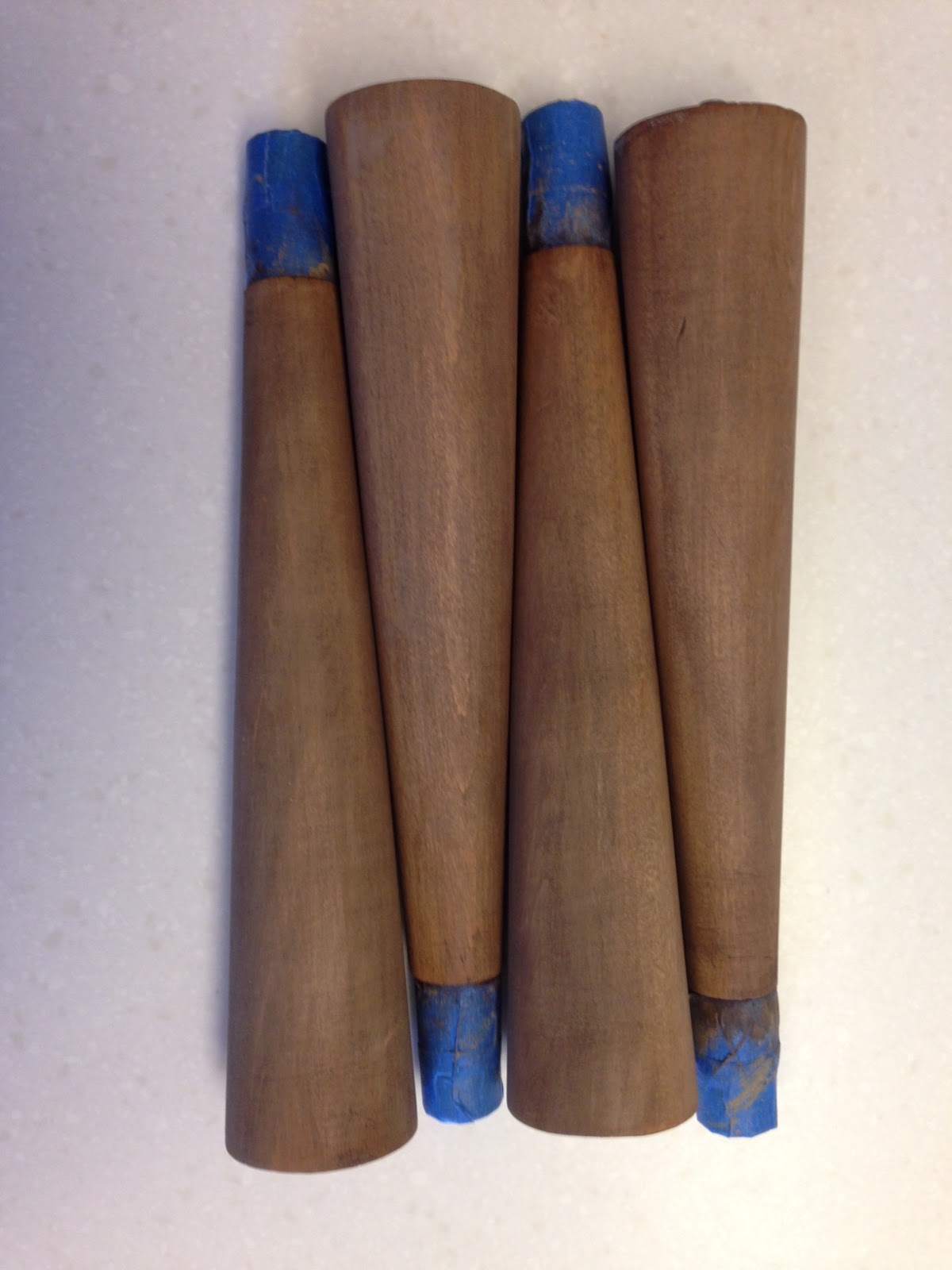
The legs had a coat of tan paint over the original blonde finish and they’d been scuffed up a bit.


I didn’t care about the paint or the scuff marks because I was going to refinish the legs to match my cabinet. I used wood stripper and a teflon pad to remove the old paint and the original finish.


Next, I applied a walnut stain which I knew would be too dark. I wiped off most of the stain immediately after I applied it and then used mineral spirits to make the walnut stain even lighter.


I brushed on a coat of polyurethane which contained a cherry stain. If I’d wanted the legs to be more red, I could have applied another coat of the polyurethane/stain, but they were exactly the color I wanted after one coat. 


I’m thrilled to pieces with my “new” stool and I'm sure I'll use it a lot. Happy Sewing everyone!

Saturday, April 30, 2016

New To Me Serger


Today, our small town held its annual "Big Flea," which gives people the opportunity to set up folding tables on the common and sell all the unwanted stuff they've accumulated in their garages since last year's Big Flea. We didn't see anything interesting until we came to a table with a serger. I've never used a serger, but I've always been curious about them. This one was a White Speedylock 1600 and it came with a box of accessories, a manual, a plastic cover, and four spools of thread. The only thing missing was a little plastic tray which is meant to snap on the front and collect the pieces of fabric as they're cut off by the serger's blade. The person selling it seemed to think it probably worked and she had it priced at $30, so we decided to take a chance.

The Bird's Eye View
We got it home, cleaned it a bit, oiled it, threaded it, and lo and behold it works fine. Now all I need to do is think of a reason to use a serger.  Happy sewing (and serging) everyone!

Saturday, April 9, 2016

Dogs in the Garden Quilt


In looking through my remaining flannel scraps, I found flowers, lady bugs, butterflies, salamanders, birds, and dogs. There were some scraps of pink, too. I jumbled all of these together to make squares for the quilt I finished today – Dogs in The Garden. This is another small quilt, 36 x 42 inches. I pieced the top with my Singer 201 and finished it with my Singer 401.

The back of the quilt is a piece of flannel from my stash and it continues the garden theme. No dogs on the back, though.


I used a polka dot scrap for the binding and had less than one inch left over. There was just barely enough to join the two pieces of binding. Yikes! Someone asked me how to join the two ends of the binding with a bias seam and this photo shows how to do this. One end needs to overlap the other end by the width of the binding. My binding was three inches wide, so I needed to overlap the ends by three inches. Right sides together.  Make sure the folds in the binding are as shown in the photo and also note the twist (or lack of twist) in the ends. Sew on the diagonal along the pins in the photo. That's all there is to it. 


Frieda enjoyed exploring the scrap bag while I sewed.


I hope Spring has arrived where you are. Our high temperature today was 45 degrees with stiff winds and spitting rain which is supposed to change to wet snow later this afternoon. Perfect weather for a lap quilt.

Happy sewing, everyone!


Monday, February 8, 2016

DIY Cutting Table


For a long time, I used my dining room table as my fabric cutting table. I liked the large work surface, but I didn't like the low height of the table (oh, my aching back!) and I didn't like making a mess in the dining room every time I cut a piece of fabric.

Eventually, I abandoned the dining room table and started using the twin bed in the spare bedroom as my cutting table. I put a hollow core door on top of the bed and used bed risers (those plastic things you put under the feet of a bed to raise it up) to make the work surface higher. I liked having a higher work surface, but it wasn't ideal because there was no overhang which meant I was bending over the whole time I was using it. Plus, I didn't like giving up the spare bedroom. And, the hollow core door wasn't as large as my cutting mat, which is 3x4 feet.

I looked online to see if I could find a cutting table I liked. A lot of them weren't tall enough for me. Others were designed to hold a sewing machine, which I didn't need. Others had lots of drawers, but I wanted a large open space under the table. Still others were (in my view) ridiculously expensive.

So, one morning after breakfast, I made a quick sketch of what I wanted and E headed to the shop. The end result was my new cutting table. The table top is 4x4 feet of 3/4 inch plywood, which is big enough for my cutting mat and leaves space along the back edge for a lamp, fabric weights, boxes of pins, etc. The framework is made of 2x4s and it's 36 inches wide and 33 inches deep, so I have a nice overhang on each edge. The wheels caster so I can roll it around the room in any direction and wherever I want. The height to the top of the work surface is 37 inches, which is exactly what I wanted. The sides and the back are pegboard where I can hang my rulers and my smaller cutting board. In the big open space in the front, I put an old two-door chest which holds all of my spray "stuff" -- starch, sizing, temporary bond, permanent bond, etc. Next to the chest is my embroidery machine. (Pay no attention to the cow. She's purely decorative.)


My sewing room is on the second floor of our house and there was no way we could possibly carry this up a flight of stairs or get it through any of the doors. So, we turned it into a flat pack and put some of the pieces together in the shop, carried them upstairs to the sewing room, and assembled it there.

I am thrilled with my cutting table and look forward to using it soon. Happy sewing, everyone!

Sunday, January 10, 2016

Dresden Circle Flannel Quilt


This is the fourth quilt I've made from the box of flannel scraps someone gave me several months ago. The box contained some skinny triangles and I trimmed twenty of them and stitched them together into this Dresden circle. I pieced together enough of the pink (with tiny pink dots which you can maybe see in the next photo) to make a border and I used the last few bits of the off-white to make the binding, which I attached using my Singer 401.


I put some extra batting under the circle so it stands up about an inch from the face of the quilt, and I didn't quilt the Dresden pieces because I decided I liked the way it looks as it is. This quilt is 36 x 36 inches, which is about the same size as the previous three small flannel quilts I made from this same box of scraps. The box isn't quite empty, but it's getting close. It's been fun, and a little challenging, to sift through the pile of scraps and come up with ideas for combining them into a series of small quilts. 

Happy sewing, everyone!  

Wednesday, January 6, 2016

The Featherweight's New Clothes


This afternoon, I had a couple of spare hours and a pile of fleece scraps, and the Featherweight ended up with some snazzy new duds. There's a tiger striped sock which protects the bed, including the hinged piece.


There's also a gusseted bag which gives the machine some extra protection when it's in the case.


Happy sewing, everyone!  

Sunday, November 29, 2015

Zippers and Drawstrings


I pulled some cotton pieces from my box of scraps and 
used them to make a few
zippered pouches and drawstring bags


Happy Sewing Everyone!

Monday, November 2, 2015

Singer 2404 reverse repair


Several years ago, I saw this machine listed for sale on eBay. When I asked the seller about packing it for shipment, she said all the right things, so I placed my bid. Unfortunately, my bid was the high bid. 

When the machine arrived, it was in a cardboard box without any packing material at all. None. Zero. Zip. Nada. Not a wadded up newspaper. Not a single packing peanut. Nothing. The machine was in its original case (which was one of the reasons I wanted it), but the box was too small for the case, and during shipment the handle on top of the case was crunched down into the top of the case, which broke the handle and cracked the top of the case. Because there was no packing material whatsoever, the bottom of the case had broken into a dozen pieces. The foot controller had rattled around, broken into several chunks, and spewed graphite disks everywhere. The top of the machine (the part with the spool holder on it) was cracked and bent. Considering the complete lack of packing material, I was surprised the machine wasn't in worse shape. 

When I contacted the seller, she seemed genuinely surprised when I told her about the machine's condition. After we talked about it, we agreed I would keep the damaged machine and she would refund my shipping costs plus half of my purchase price. I hadn't paid much for the machine, so this was a fair deal for both of us, I think. 

I junked the many, many pieces of plastic and found replacements for the top of the machine and the foot controller. I've never found another original case (still hoping, though!), but I did find a new case which fits the machine the same way the old one did. I also picked up a Singer 1862 at a rummage sale because it came with a box of cams which will fit this machine. 

In the photo above, you can see a big pink button on the right front side of the machine. When you push it in and hold it in, the machine is supposed to reverse. The machine ran like a champ -- going forward and in reverse -- until recently when it decided it didn't want to stitch in reverse. E took a look at it today and the solution wasn't obvious, but it was simple. 

The arrows in the next photo point to two set screws on the bottom of the machine.


The one on the top was super loose. The one on the bottom was a little bit loose. These set screws hold the bearings for the rods which control the feed dogs and because the rods were loose, the feed dogs weren't willing to reverse. Once E pushed the bearings over to the left to take the play out of the rods and tightened the two screws, the problem was solved. Now the 2404 sews a nice stitch going forward and in reverse. Yay! 

Thursday, October 29, 2015

Singer 15-91


Well, folks, another one followed us home. In early June, we met a fellow who inherited a Singer 15-91 (this one was made in 1950) and wanted to get rid of it. The good news: The machine wasn't missing any parts and came with a box of accessories, the foot controller, the power cord, and the little green instruction booklet. The perhaps not so good news: For some reason, all the electrical wiring had been disconnected. Because there's always room for one more sewing machine, we loaded it in the back of the Spark and brought it home.

We had a lot of things going on this summer and didn't have a chance to take a good look at the machine right away. When we did, we found it was a tad dirty, which was no surprise. Take a good look at the feed dogs. Not the worst we've seen, but still pretty icky.


We cleaned the machine, oiled and greased it, polished the chrome parts, and replaced the light bulb with a cooler, brighter LED bulb. E used gold acrylic paint on the stitch length regulator so we can see the numbers. (See how to do this at http://vssmb.blogspot.com/2011/07/how-to-restore-your-stitch-length.html). Before he did this, the numbers weren't visible at all.


He took off the motor, inspected it thoroughly, cleaned a few things, and replaced the wicks. We started thinking about the reasons someone would disconnect all of the wiring from a machine and decided the number one reason would be to keep the house from burning down, so we replaced the power and pedal cords. As we worked on the machine, we ran it through its paces using the hand wheel (no power) many, many times. When we finally plugged it in and gave a cautious, light press on the foot controller, the machine didn’t smoke or burst into flames. In fact, it ran steadily and smoothly. Yay!

I had to read the instruction manual to figure out how to thread it on top – In my defense, it’s a bit odd. Then, I sent a bunch of scraps through and it made a nice, even stitch. Its new home is a cabinet (with a knee controller) we found at a thrift shop and refinished a while ago. Now all I have to do is decide what to sew for its first project as a new-to-me machine. Happy Sewing Everyone!

Saturday, October 24, 2015

Kenmore 1040


Yesterday, I went to a church rummage sale and found a plastic, rose-covered carrying case with a $10 price tag hanging from it. When I picked it up, I knew something was in there and when I looked underneath, I could see it was a Kenmore 158.1040. I headed for the check out line.


When I got home and opened the case, the 3/4 size Kenmore was nestled inside. It's 12.75 inches long, 5 inches wide, and 10 inches tall. The throat is almost 7 inches at its widest point. I haven't stepped on the scale with it, but I'm guessing it weighs a little more than 15 pounds. 


If you're wondering where the thread spool pin is, it's down inside the machine. You pull it up when you want to sew and push it down before you put the machine back in the case. The little flip-out accessory box was there and inside were three presser feet (a fourth foot was on the machine), a blind stitch guide, four buttonhole guide feet, one extra bobbin, a needle, a needle plate for zigzag stitching, and a couple of screw drivers. 


To create extra bed space, the accessory box rotates forward and the hinged extension on the end flips up.


The accessory box comes out and behind it is where you find your bobbin and the lever to lower the feed dogs.


E and I cleaned it and oiled it. To do this, we opened the cover plate on the end with the light bulb and then popped off the cover plate on the top of the machine. On the end with the hand wheel, the cover plate is held in place by a screw at the bottom and by a pin at the top. The pin is held in place by a screw (see next photo) which we had to loosen before we could remove the side cover plate. The bottom of the machine is held in place with a few screws, too. We downloaded a free manual from the Sears parts website and it shows where the oiling points are.


After we had everything cleaned and oiled, one problem became apparent right away: The clutch on the hand wheel wouldn't release. We Kroiled the living daylights out of it and left it overnight.  Here's where we put the Kroil:


This morning, I tried releasing the clutch and was surprised when it broke free very easily. The only other problem we found is the feed dogs don't drop. We're hoping the Kroil will work its magic on them. If not, it's no big deal. 

[Update: Eureka! Two days after I posted this, we got the feed dogs to drop. On the underside of the machine, there’s a rod with a pointed tip which passes through a cylinder and pokes out through a ring. (If you have your machine on its back with the bobbin case facing up, the rod/cylinder/ring are to the right of the bobbin case.) When you turn down the lever to drop the feed dogs, the rod ought to pull back from the ring and go into the cylinder. Our rod wasn’t moving, so we Kroiled and heated it until it finally moved freely back and forth in the cylinder. Alas, the feed dogs still wouldn’t drop because even though the rod was pulled back into the cylinder, the ring continued to move up and down when the cylinder moved up and down. There are a couple of joints between the ring and the feed dogs and after we Kroiled and heated those, we finally got the action we wanted.]

The moment of truth finally arrived when we plugged in the machine and started sewing. It made a straight stitch very easily and after it had warmed up a little bit, it began to zigzag and do all of the other built-in stitches. It does a special mending stitch, a blind stitch, and a stretch stitch. There are three other settings on the special stitch dial which you use to make buttonholes. 

I didn't exactly need another sewing machine, but I couldn't resist this little guy. Happy sewing everyone!